
-
A vitamin B12 deficiency test is one of the most misunderstood parts of a routine workup, and getting it right can change everything. Most patients who walk into my office worried about low energy expect one blood test to answer the question: is my vitamin B12 low? I wish it were that simple. The truth I share in every visit is that a single number on your lab slip can look perfectly normal and still miss a real deficiency. That is why I do not stop at one test. I use four.
In this guide I walk you through the four lab tests I actually order — what each one measures, where each one falls short, and how I read them together to give patients an honest answer. If you have been told your B12 is “fine” but you still feel tired, foggy, or tingly, this is the read you have been looking for.
Why one vitamin B12 deficiency test is rarely enough
The standard serum vitamin B12 test measures how much B12 is floating in your bloodstream at the moment of the draw. It does not measure how much of that B12 is actually reaching your cells and doing its job. That is a critical difference.
Labs usually flag deficiency when serum B12 falls below 200 to 250 pg/mL, though the exact cutoff varies by lab and method (NIH Office of Dietary Supplements). Here is the problem I see in real practice: patients land in the 250 to 400 pg/mL range, get told they are “normal,” and continue to lose feeling in their fingertips for another two years.
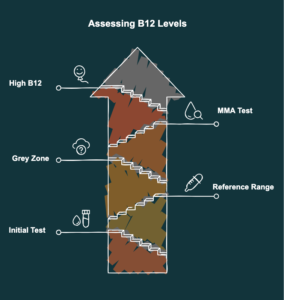
The NIH itself acknowledges the gap and recommends that when a patient sits between 150 and 399 pg/mL, we should reflex to methylmalonic acid (MMA) to confirm what is really happening at the cellular level. That is the single most important sentence in this article. Serum B12 is a screen, not a verdict.
The four lab tests I order — and how to read them
Below is the panel I actually build for a patient with suspicious symptoms or a borderline number. No single test is perfect. Together they tell the story.
1. Serum vitamin B12 — the starting point, not the finish line
This is the test most patients already have on their chart. It is cheap, widely available, and included in most routine panels. Use it to screen, not to rule out.
- What it measures: total B12 circulating in the blood at the moment of the draw.
- Typical reference range: roughly 200 to 900 pg/mL, with subnormal generally defined as below 200 to 250 pg/mL.
- Where it fails: a “normal” number can still miss a real deficiency, especially in the 200 to 400 pg/mL grey zone.
- What I do: if the number is under 400 pg/mL and symptoms are present, I do not stop here. I reflex to MMA.
A separate question I hear often: “My B12 is over 2000 — should I be worried?” In almost every case, no. B12 is water-soluble, so the excess is filtered by your kidneys and excreted in urine (Mayo Clinic). Unexplained elevation without supplementation is uncommon and, when persistent, deserves a closer look at liver and kidney function — but supplement-driven high numbers are not toxic.
-
2. Methylmalonic acid (MMA) — the most sensitive marker I have
When people ask me what the “gold standard” B12 test is, this is the one I point to. MMA is a metabolite that builds up when your cells do not have enough active B12 to run one of their key enzyme reactions. If MMA is high, your cells are hungry — even if your serum B12 looks acceptable.
- What it measures: a downstream metabolite that rises when cellular B12 activity drops.
- Elevated threshold: serum MMA greater than 0.271 μmol/L suggests deficiency, per NIH.
- Where it fails: MMA can also rise with reduced kidney function and tends to run higher in older adults, so I always interpret it alongside creatinine.
- What I do: I order MMA whenever serum B12 sits between 150 and 399 pg/mL, or when a patient has neurologic symptoms regardless of the serum number.
3. Homocysteine — the second-look functional marker
Homocysteine is another amino acid that piles up when B12 (or folate) is not doing its metabolic job. It is fast to rise and can flag a functional deficiency the serum test misses.
- What it measures: a functional signal of B12 and folate activity.
- Elevated threshold: a total plasma homocysteine higher than 15 μmol/L suggests B12 deficiency, per NIH.
- Where it fails: homocysteine is less specific than MMA. It also climbs with low folate and worsening kidney function, so it is not a stand-alone diagnosis.
- What I do: I pair it with MMA. If both are elevated and B12 is low or borderline, the case for deficiency is strong.
4. Mean corpuscular volume (MCV) — the free clue on your CBC
MCV is not a B12 test per se — it is the average size of your red blood cells, reported on the standard complete blood count that almost every patient already has. When B12 (or folate) runs low, red cells enlarge and become inefficient at carrying oxygen. That is megaloblastic anemia.
- What it measures: average red blood cell size, from your CBC.
- Watch above: roughly 96 fL and up warrants a closer look for B12 or folate deficiency (Merck Manual).
- Where it fails: MCV can stay normal early in deficiency and can be masked when iron deficiency is also present, because iron deficiency shrinks red cells and cancels out the enlargement.
- What I do: a rising MCV on serial CBCs, even within “normal” range, is a real yellow flag — and a cue to order MMA.
Why B12 quietly disappears — the absorption story
Understanding how B12 is absorbed explains why so many otherwise healthy adults slide into a deficiency. Every bite of B12 has to survive a four-step journey:
- Mouth and stomach: stomach acid and pepsin free B12 from the animal protein it was bound to in food.
- Stomach lining: parietal cells release intrinsic factor, a carrier protein that B12 must attach to.
- Small intestine (ileum): specialized receptors in the distal ileum pull the B12–intrinsic factor complex across the gut wall.
- Bloodstream and cells: B12 is delivered to bone marrow, nerves, and the brain.
Break any one step and B12 status quietly slips. Common breakers I see in clinic:
- Long-term acid suppression: PPIs like omeprazole and lansoprazole, and H2 blockers like famotidine, reduce the acid needed to release food-bound B12 (NIH).
- Metformin: a first-line diabetes drug that can lower serum B12 with prolonged use.
- Aging and atrophic gastritis: stomach acid production drops with age, and atrophic gastritis affects about 8% to 9% of adults 65 and older.
- Pernicious anemia: an autoimmune attack on the cells that make intrinsic factor — the most common cause of clinically evident B12 deficiency worldwide.
- Gut disease: Crohn’s and celiac disease can damage the ileum, the exact spot where B12 is absorbed.
- Gastric bypass or partial gastrectomy: surgical loss of acid-producing and intrinsic-factor-producing cells.
- Vegan and strict vegetarian diets: natural B12 lives in animal foods, so plant-only eaters need fortified foods or a reliable supplement.
- Heavy alcohol use: chronic alcohol impairs both stomach and gut absorption.
Symptoms that should push you toward the full panel
Many of these symptoms overlap with thyroid disease, depression, and even early dementia — which is exactly why I test rather than guess.
- Persistent fatigue that does not improve with sleep
- Tingling, numbness, or “pins and needles” in the hands or feet
- Balance changes or a subtle gait problem
- Brain fog, forgetfulness, or trouble concentrating
- Mood dips or unexplained low motivation
- Pale or yellow-tinged skin
- Shortness of breath and a fast heartbeat on light activity
- A smooth, sore, or beefy-red tongue
If two or more of these are present — especially with a borderline serum B12 — that is a full-panel case in my clinic, not a “recheck in a year” case.
What happens if you leave it alone
Untreated B12 deficiency has two problems worth respecting.
- Megaloblastic anemia. Red cells enlarge, oxygen delivery drops, and you feel it as exhaustion, pallor, breathlessness, and a racing pulse.
- Neurologic damage. Nerves lose their protective coating, causing numbness, weakness, gait trouble, and cognitive slowing. Early neurologic changes usually reverse with treatment. Delayed changes may not.
The nervous system is where the real cost lives. I would rather over-test at 300 pg/mL than under-treat at 150 and watch a patient lose sensation in their feet.
Should you just supplement instead of testing?
This is one of my most common patient questions. My honest answer: it depends on the setup.
- If you have symptoms — test first. Starting a supplement can normalize the serum number within days and hide the underlying cause, especially pernicious anemia or a malabsorption problem that needs treatment beyond a pill.
- If you are on metformin or a long-term PPI — check a baseline and repeat annually. Prevention is cheaper than a workup for neuropathy.
- If you are vegan, over 65, or post–bariatric surgery — routine B12 is reasonable, ideally in a form your body can use reliably.
A brief note on supplement forms: cyanocobalamin is the most studied and reliably absorbed form for most people. Some patients with a known MTHFR gene variant or clear symptom-lab mismatch may do better on methylcobalamin, but that is a conversation with your clinician, not a self-diagnosis.
What to ask your doctor at your next visit
- “Can we order serum B12, MMA, homocysteine, and check my MCV together?”
- “If my B12 is between 150 and 399, will you reflex to MMA?”
- “Am I on any medications — like metformin or a PPI — that lower B12?”
- “Given my diet and family history, should I be on a preventive supplement?”
These four questions get you a real answer instead of a shrug.

-
Frequently asked questions
Is a normal serum B12 enough to rule out deficiency?
No. Serum B12 measures circulating vitamin, not how well your cells are using it. When symptoms are present and the number sits between roughly 150 and 399 pg/mL, the NIH recommends reflexing to methylmalonic acid to confirm.
Which B12 test is the most accurate?
Methylmalonic acid (MMA) is the most sensitive single marker, because it reflects what is happening inside your cells rather than in your bloodstream. It is best interpreted alongside serum B12, homocysteine, and MCV.
Can medications cause a B12 deficiency?
Yes. Long-term proton pump inhibitors, H2 blockers, and metformin can all reduce B12 absorption or serum levels. If you take any of them regularly, an annual B12 check is a reasonable precaution.
Why is my B12 over 2000 pg/mL?
The most common reason is supplementation — B12 is water-soluble, and the excess is excreted in urine. Persistently elevated levels without supplementation deserve a closer look at liver and kidney function.
Can B12 deficiency cause permanent nerve damage?
Yes, if it is missed for long enough. Early neurologic symptoms — tingling, mild weakness, balance changes — usually reverse with treatment. Late changes may not fully recover, which is why testing early matters.
The bottom line
One B12 test is a screen. Four tests read together are an answer. If you are tired, foggy, or losing feeling in your fingertips, do not settle for a “normal” serum number. Ask for the full panel — serum B12, MMA, homocysteine, and MCV — and read them as a team.
Educational content only. This article is not a substitute for personalized medical care. Please discuss any testing or treatment decisions with your own clinician.
References
Related reading on the vitamin B12 deficiency test
A vitamin B12 deficiency test makes more sense alongside the rest of your bloodwork. If your CBC looks off, my guide on what a high white blood cell count means helps you read those numbers in context, since MCV overlaps with the B12 picture.
If you want a physician to order and interpret a vitamin B12 deficiency test for you, you can start with a virtual urgent care visit or learn what telehealth is and how it makes lab work and follow-up on a vitamin B12 deficiency test easier.
Quick recap: a vitamin B12 deficiency test is most useful when serum B12, MMA, homocysteine, and MCV are read together. If any vitamin B12 deficiency test result lands in the grey zone, do not settle for a single number — confirming a true vitamin B12 deficiency test result protects your nerves and energy long term.
Who should ask for a vitamin B12 deficiency test? I order a vitamin B12 deficiency test for patients on metformin, older adults, vegans, and anyone with unexplained fatigue or tingling. A well-timed vitamin B12 deficiency test, repeated when borderline, is one of the simplest ways to catch a problem early. When patients ask me which single lab matters most, my honest answer is that no single vitamin B12 deficiency test tells the whole story.