
Written and reviewed by Dr. Kulmeet Kundlas, MD — Board-Certified in Internal Medicine. Updated July 2026.
A high white blood cell count is one of the most common lab findings patients ask me about. One of the most common questions I hear in my clinic starts something like this: “Doctor, my blood test came back and one number is highlighted in red. It says my white cell count is high. Am I okay?”
If that’s you right now, take a breath. In the vast majority of people, an elevated white blood cell count — the finding doctors call leukocytosis — is your immune system doing exactly what it’s supposed to do. But there’s a smaller group of situations where the same number tells a completely different story, and knowing the difference is what this article is about.
Let me walk you through it the way I’d explain it to a patient sitting across from me — plain language first, then the deeper clinical detail if you want it.
So What Exactly Is Leukocytosis?
Leukocytosis simply means your total white blood cell count is above the normal range for your age. It’s a lab finding, not a diagnosis. Think of it the way you’d think of a fever — a fever isn’t itself the illness; it’s a signal that something else is going on that needs to be sorted out.
In healthy adults who aren’t pregnant, the typical white blood cell count sits between about 4,500 and 11,000 cells per microliter. Anything above 11,000 is generally labeled leukocytosis (NIH StatPearls, 2026; American Family Physician).
What’s “Normal” Depends on Who You Are
The reference range isn’t the same for everyone. Newborns run much higher counts than adults, and pregnancy pushes the number up too. Here’s what typical looks like across life:
| Life stage | Normal WBC range (cells/µL) |
|---|---|
| Newborn (first hours of life) | 13,000 – 38,000 |
| Two-week-old infant | 5,000 – 20,000 |
| One-year-old | 6,000 – 17,500 |
| Ten-year-old | 4,500 – 13,500 |
| Adult (not pregnant) | 4,500 – 11,000 |
| Third-trimester pregnancy | 5,800 – 13,200 |
Data adapted from StatPearls (NIH).
How High Is High? A Practical Way to Think About It
Not all leukocytosis carries the same weight. In clinical practice, I mentally sort a high count into a few tiers — this is roughly the framework I use at the bedside:
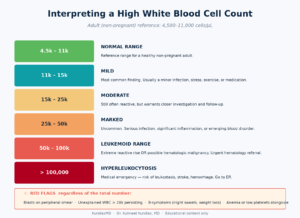
- Mildly high (11,000 – 15,000): By far the most common finding. Usually reactive to something minor — a cold, some stress, a recent workout, or a medication.
- Moderately high (15,000 – 25,000): Still often benign, but I look harder for a source.
- Markedly high (25,000 – 50,000): Uncommon. Serious infection, significant inflammation, or an emerging blood disorder needs to be considered.
- Leukemoid range (50,000 – 100,000): An extreme reactive response, or possibly a hematologic malignancy — this one gets referred to hematology quickly (Leukemoid reaction reference).
- Hyperleukocytosis (over 100,000): A true medical emergency. Risk of leukostasis, which can cause stroke or hemorrhage. Straight to the hospital (AAFP).
Why Would White Cells Go Up?
Roughly nine out of every ten times I see leukocytosis, it turns out to be reactive — the bone marrow ramping up production because the body is dealing with something. Here are the categories I run through, in the order I usually consider them:
Infections and Inflammation
Bacterial infections are the classic trigger. But viruses, fungi, parasites, and tuberculosis can all drive counts up too. Autoimmune conditions such as rheumatoid arthritis, inflammatory bowel disease, and vasculitis behave similarly — the body’s immune machinery is running hot.
Physical Stress on the Body
Recent surgery, burns, a heart attack, or major trauma will all bump the WBC. So can something as simple as a hard workout, a seizure, or intense emotional stress — usually a short-lived rise driven by adrenaline and cortisol.
Medications
Corticosteroids like prednisone are probably the sneakiest cause of leukocytosis I see in primary care. A patient starts a steroid taper for asthma or a joint flare, and their next CBC comes back high. Other culprits: lithium, beta-agonists, epinephrine, and drugs like G-CSF that are given specifically to raise counts.
Smoking and Pregnancy
Long-term smokers often carry a persistently elevated WBC — nothing more sinister than the chronic low-grade inflammation of smoking. Pregnancy, especially the third trimester and postpartum period, also naturally raises the count.
The Endocrine Angle
Hyperthyroidism, Cushing’s syndrome, and adrenal disorders can all show up on the CBC as leukocytosis. It’s not the first place I look, but if the obvious causes are ruled out, hormones deserve a check.
The One We Can’t Miss: Blood Cancers
This is the small but critically important group. Acute leukemias (AML, ALL), chronic leukemias (CML, CLL), myeloproliferative neoplasms like polycythemia vera or essential thrombocythemia, and some lymphomas can all present with a high white count. The count alone doesn’t tell us — the differential and the smear do (American Society of Hematology).
The Differential Matters More Than the Total
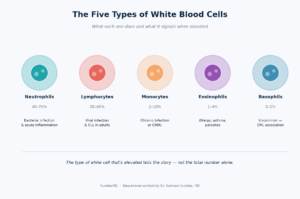
Here’s a point I emphasize with every patient: the total WBC number is only the headline. What tells the real story is the differential — the breakdown of which type of white cell is elevated. Your CBC report shows this in the lines just under the total.
Here’s the quick translation guide I use in my head:
- Neutrophils high (neutrophilia): Think bacterial infection, injury, steroids, stress. This is the most common pattern by a wide margin.
- Lymphocytes high (lymphocytosis): Think viral infections (mono, CMV, hepatitis, pertussis), tuberculosis. In older adults, a persistent lymphocytosis over 10,000 is CLL until proven otherwise.
- Monocytes high (monocytosis): Think chronic infections, autoimmune disease, or the myeloid disorder CMML.
- Eosinophils high (eosinophilia): Think allergies, asthma, parasites, drug reactions, or eosinophilic disorders.
- Basophils high (basophilia): Uncommon and worth attention — a strong association with myeloproliferative disease, especially CML.
The Bottom Line on a High White Blood Cell Count
Most of the time, a high white blood cell count is your body responding to something ordinary and temporary. The key is context: your symptoms, the differential, and how the number trends over time. If you want to understand what the rest of your blood panel means, read our guide to understanding your Complete Blood Count (CBC). And if your high white blood cell count is very high, keeps climbing, or comes with fevers, night sweats, or unexplained weight loss, don’t wait — talk to your doctor promptly. Remember: a high white blood cell count is a clue, not a diagnosis, so tracking your high white blood cell count over time with your physician matters more than any single reading.